


Singapore Start-Up Tax Exemption (SUTE) for Indian Founders: 3 Powerful Tax Benefits

For Indian founders, the Singapore Start-Up Tax Exemption can influence how they evaluate the tax efficiency of a new Singapore entity.
Singapore Start-Up Tax Exemption (SUTE) can significantly reduce the corporate tax burden for qualifying new companies. For Indian founders considering Singapore as an international business hub, understanding the eligibility conditions, ownership requirements and Indian regulatory implications is essential before incorporation.
Singapore charges companies a flat 17% corporate income tax rate. An Indian company on the concessional regime pays about 25.17% once surcharge and cess are added. For a young Singapore company, the effective tax burden can be lower because of the exemption available on part of its initial profits.
That relief is the Start-Up Tax Exemption, or SUTE. It is easy to claim and just as easy to lose, and many Indian founders find out which only after they have incorporated. This note sets out how it works, who qualifies, what it is actually worth, and where it meets Indian rules.
Quick answer. A newly incorporated Singapore company that qualifies for SUTE pays no tax on 75% of its first S$100,000 of chargeable income and 50% of the next S$100,000, in each of its first three consecutive years of assessment. That is up to S$125,000 exempt a year. The effective rate comes to 4.25% on the first S$100,000 and 6.38% on S$200,000. At least one individual must hold 10% or more of the shares.
How much tax you pay under the Singapore Start-Up Tax Exemption
Singapore taxes a financial year’s profit in the following year of assessment (YA), so profit earned in FY2026 is assessed in YA 2027. SUTE covers the first three consecutive years of assessment. After that, or if the company fails the shareholding test, it falls back on the partial tax exemption (PTE), which every company receives.
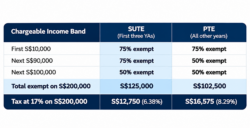
The comparison that matters is the one on the right. Against the PTE that any company gets anyway, SUTE exempts at most S$22,500 more income a year. At 17% that is S$3,825 of tax a year, or S$11,475 over the three years, and only once profit reaches S$200,000. Against paying the full 17% the saving is larger, but it is worth being clear about which comparison you are making.
The Singapore Start-Up Tax Exemption therefore provides an additional tax advantage over the Partial Tax Exemption, subject to the company’s eligibility.
One-off rebates sit on top and change with each Budget. For YA 2026 the rebate was 50% of tax payable, capped at S$40,000 including a S$2,000 cash grant that requires at least one local employee. As of this update nothing has been announced for YA 2027, so we leave rebates out of the numbers in this note.
Who qualifies for the Singapore Start-Up Tax Exemption
The company has to meet every condition in each year of assessment:
- It is incorporated in Singapore. A Singapore branch of an Indian company does not qualify.
- It is a Singapore tax resident for that year (see the residency section below).
- It has no more than 20 shareholders throughout the year.
- Either all of its shareholders are individuals, or at least one individual holds 10% or more of the ordinary shares, directly and beneficially.
Meeting the Singapore Start-Up Tax Exemption eligibility conditions is essential before a company can claim these benefits.
For the official eligibility conditions and tax exemption calculations, refer to the IRAS guidelines on the Start-Up Tax Exemption Scheme.
Nothing in these conditions asks for a Singaporean shareholder or director. A foreign founder can own the whole company and still claim.
The corporate subsidiary trap
The usual route for an Indian group is to incorporate Singapore as a 100% subsidiary of the Indian company. That fails the fourth condition, because no individual holds shares directly. The company is not disqualified from anything else, but it gets the partial exemption instead of SUTE. If the exemption matters to the plan, at least one individual has to hold at least 10% personally, and that investment has to sit within RBI’s rules for overseas investment by individuals, covered below.
Activities that are excluded
Two kinds of company are outside SUTE even if every condition is met: investment holding companies, and companies that develop properties for sale or investment. A software, services or trading business is not affected.
For Indian founders, the Singapore Start-Up Tax Exemption is only one part of the decision; the ownership structure and applicable Indian tax rules also matter.
Case study: claiming the Singapore Start-Up Tax Exemption two ways
A founder in Bengaluru runs a B2B software company in India. Enterprise customers in Singapore, Malaysia and Indonesia want to contract with a Singapore entity and pay in SGD or USD, so she decides to incorporate a Singapore private limited company to sign and bill them. Product development stays with the Indian company, which charges the Singapore company a cost-plus service fee. Assume the Singapore company has S$200,000 of chargeable income in each of its first three years.
She has two ways to hold the shares.
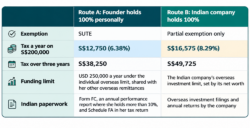
On paper Route A saves S$3,825 a year and S$11,475 over three years. That is real money, but it is the smaller part of the decision. What should decide it:
- How the company will be funded. If she needs more than the individual limit allows, or the Indian company has the cash and the net worth, Route B may be the only practical option.
- Who receives the profit later. Dividends reach her personally under Route A and pass through the Indian company under Route B.
- Where the company is run. Under either route the Singapore company has to be managed from Singapore: a resident director, board meetings held there, and customer contracts negotiated and signed there.
- The Indian side of the arrangement. The cost-plus fee between the two companies has to be written down and priced at arm’s length.
Our advice in a case like this is to pick the route for how the business will be funded and controlled, and to treat SUTE as a bonus. If she can fund the company within her individual limit and wants to hold the shares herself, Route A is usually the better fit. If she cannot, Route B costs about S$3,825 a year more in Singapore tax at this profit level and is easier to fund.
The residency question: where the company is run
A company incorporated in India is an Indian tax resident by definition. Singapore asks a different question. A company is a Singapore tax resident if its control and management are exercised in Singapore, which means where its strategic decisions are made, usually where the board meets. Incorporating there does not settle it.
This is where remote founders get caught. If every founder stays in India, decisions are taken on calls, and a nominee director signs the paperwork, IRAS can treat the company as non-resident. Two things follow. SUTE is lost, because it needs a Singapore tax resident. And IRAS will not issue a Certificate of Residence, so the company cannot claim treaty relief under the India–Singapore tax treaty.
The fix is practical rather than clever:
- Hold board meetings in Singapore and keep proper minutes.
- Use a resident director who takes part in decisions, not one who only signs.
- Keep travel records and decision records that show where the company is actually managed.
The Indian rules point the same way. A foreign company is resident in India if its place of effective management is in India. That test is in Section 6(10) of the Income-tax Act, 2025, which replaced Section 6(3) of the 1961 Act from 1 April 2026. It asks where key management and commercial decisions are, in substance, made. CBDT has said its POEM guidelines do not apply to a foreign company with turnover or gross receipts of ₹50 crore or less, and a company in its early years will often sit under that line. Building real substance in Singapore from the start is still cheaper than rebuilding it once the business has grown.

What RBI and Indian tax add
Singapore’s rules are only half the picture. A resident Indian who subscribes to shares in a Singapore company is making an overseas direct investment, and the Foreign Exchange Management (Overseas Investment) Rules, 2022 apply.
- How the money goes. Through an Authorised Dealer Category-I bank. For an individual the limit is USD 250,000 a financial year under the Liberalised Remittance Scheme, counted across all permitted overseas remittances. Larger remittances can attract tax collected at source, so ask your bank before you wire.
- What it can be. An operating business. Resident individuals cannot invest in financial services entities, and an individual who controls a foreign entity cannot set up step-down subsidiaries abroad.
- What gets filed. Form FC through the bank, and an annual performance report where the individual holds more than 10%. An Indian company that invests abroad files its own annual returns, including the foreign liabilities and assets return. Late filings carry a late-submission fee, so file on time.
On the way back, Singapore’s one-tier system means tax is paid at company level and dividends are not taxed again in Singapore, with no withholding tax. In India, a dividend from the Singapore company is taxable in the shareholder’s hands at slab rates, and the shareholding has to be disclosed in Schedule FA of the Indian return.
For the applicable regulatory framework, refer to the RBI Master Direction on Overseas Investment.
How to claim the Singapore Start-Up Tax Exemption
There is no separate application for SUTE. IRAS works it out when you file, provided you say the company qualifies.
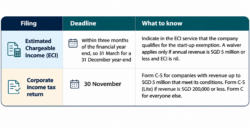
Two points catch people out. ECI is reported before any exemption, so do not deduct SUTE yourself. And the ECI waiver is for a nil ECI, not a small one.
Questions we hear most often
Can an Indian resident own 100% of a Singapore company and still get SUTE?
Yes. The company must be incorporated in Singapore, be a Singapore tax resident, have no more than 20 shareholders, and have at least one individual holding 10% or more of the ordinary shares. A founder holding all the shares meets the last test.
What if the Singapore company is a wholly owned subsidiary of an Indian company?
It does not qualify for SUTE, because no individual holds shares directly. It gets the partial exemption instead: 75% of the first S$10,000 and 50% of the next S$190,000 are exempt, up to S$102,500 a year.
Does the Singapore Start-Up Tax Exemption last as long as the company is young?
No. It covers the first three consecutive years of assessment, then the partial exemption takes over. IRAS looks closely at companies that appear to have been set up or restructured mainly to obtain the exemption, so a new company needs a genuine commercial reason.
Are dividends taxed when they reach the founder?
Not in Singapore, which has no withholding tax on dividends. In India, a resident shareholder pays tax on the dividend at slab rates and discloses the shareholding in Schedule FA.
How is SUTE different from the corporate income tax rebate?
SUTE reduces chargeable income before the 17% rate applies. A rebate is a percentage taken off the tax payable after exemptions, and it is announced Budget by Budget. YA 2026 had a 50% rebate capped at S$40,000. None has been announced for YA 2027.
Conclusion
SUTE is a useful relief and worth planning for. It is also smaller than it first appears. Against the partial exemption that every company receives, it is worth at most S$3,825 a year in tax, and only to a company earning S$200,000 or more. It should never be the reason to set up in Singapore. It is one input into a structure chosen for how the business will be funded, run and eventually paid out.
What separates the structures that work from the ones that cause trouble is rarely the exemption. It is the basics: the right shareholder holding the shares, a company that is genuinely managed from Singapore, RBI filings made on time, and clean pricing between the Indian and Singapore entities.
Understanding the Singapore Start-Up Tax Exemption alongside ownership, tax residency and compliance requirements can help Indian founders make a more informed expansion decision.
If you are weighing a Singapore company for your Indian business, we can look at the holding structure, the RBI route and the Singapore filings together before you incorporate. Write to us at team@tmghq.com or visit tmghq.com.

Soumik Kumar Sen
Principal — Global Expansion, Fundraising Compliance & Allied Services
Connect with Soumik on LinkedIn.
An alumnus of the Indian Institute of Foreign Trade (IIFT), Soumik brings over 10 years of experience in global business expansion, cross-border advisory and transaction compliance.
At Taxmantra Global, he leads the Global Expansion practice, overseeing the Singapore and US practices. He works closely with founders and CXOs on international market entry, fundraising compliance, ESOPs and due diligence, helping businesses build compliant global structures for sustainable growth.
