

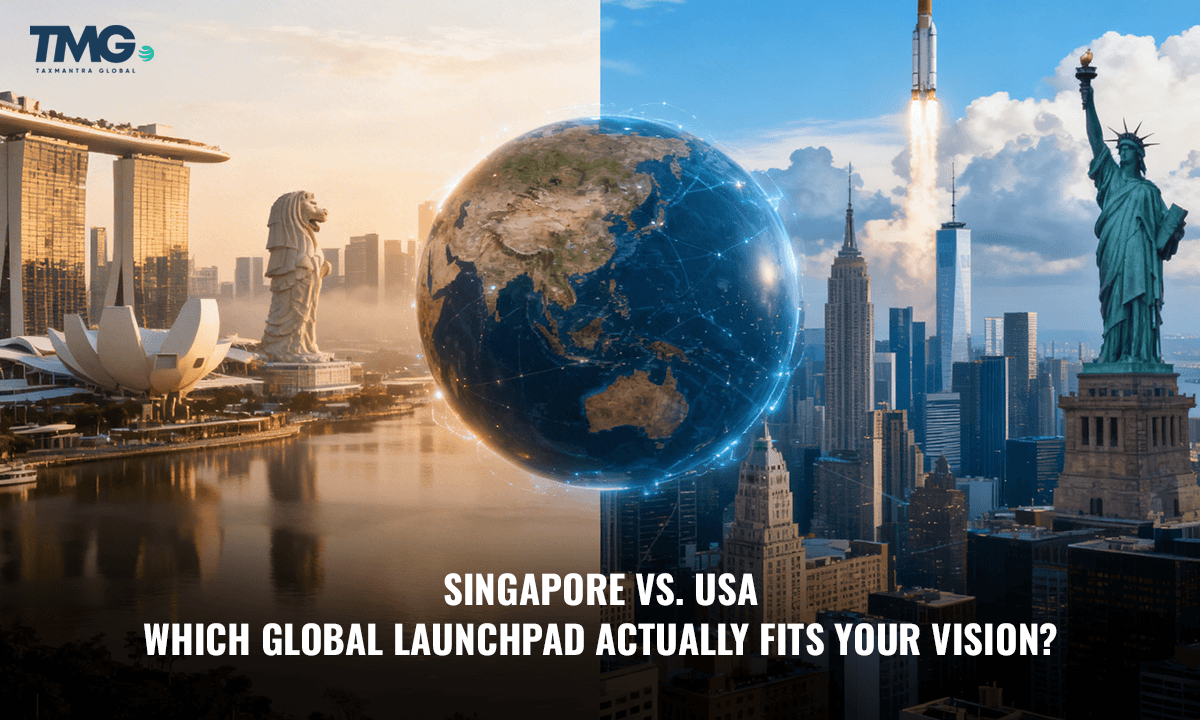
Singapore vs. USA: Which Global Launchpad Actually Fits Your Vision?
Expanding your business internationally is no longer a nice-to-have, it’s a survival strategy. But let’s address the elephant in the room: most Indian founders choose their global headquarters based on LinkedIn hype rather than a balance sheet.
You’ve heard the whispers. Singapore is a tax haven or The U.S. is the land of the unicorns. While there’s truth in both, jumping in without a roadmap is a recipe for a compliance nightmare. If you’re serious about scaling, you need to look past the shiny brochures.
Here is the unfiltered reality of Singapore vs. USA company registration, broken down by what actually moves the needle, taxation, red tape, and long-term survival.
1. The Setup: Speed vs. Substance
Singapore: The 48-Working Hour Sprint Singapore is the gold standard for efficiency. The government has digitized almost everything through ACRA (Accounting and Corporate Regulatory Authority).
- The Reality: You can literally incorporate in 2–3 days from the Filing to ACRA. With 100% foreign ownership and a minimum capital requirement of just $1, it’s the closest thing to plug-and-play business.
- The Vibe: High-speed, low-friction, and incredibly welcoming to tech-savvy founders.
USA: The State-by-State Puzzle The U.S. isn’t one “market”; it’s a collection of 50 different jurisdictions. Most founders flock to Delaware (for VC readiness) or Wyoming (for privacy).
- The Reality: Expect a 3–10 day wait. The real bottleneck isn’t the filing—it’s getting your EIN (Tax ID) and a business bank account as a non-resident, which can take weeks.
- The Vibe: Professional, bureaucratic, and requires a boots on the ground mindset.
The Brutal Truth: If you need to be open for business by next Monday, Singapore wins. The U.S. requires patience.
2. The Tax Trap: Profit vs. Presence
Singapore: The Founder’s Friend Singapore doesn’t just have low taxes; it has smart taxes. With a flat corporate rate of 17%—and exemptions that can drop your effective rate to below 5% for the first few years—it’s designed to help you keep your capital.
- Bonus: Zero capital gains tax and zero dividend tax. What you earn, you keep.
USA: The Cost of Admission The U.S. tax system is a multi-layered cake. You pay Federal tax (21%), then State tax (0%–12%), and potentially local taxes.
- The Reality: Total tax leakage can easily hit 30%. Unless you’re reinvesting every penny into aggressive growth, the U.S. is an expensive place to park your profits.
The Brutal Truth: If your goal is tax optimization and high margins, Singapore is the clear victor. The USA is where you go to spend money to make (a lot) more money.
3. Market Access: Gateway vs. Destination
- Singapore is the “Control Tower.” It’s your gateway to the ASEAN market—650 million consumers across Southeast Asia. It’s perfect for logistics, trading, and regional HQ operations.
- The USA is the “Arena.” It is the world’s largest consumer market ($27T GDP). If you are selling SaaS, D2C, or high-end tech, there is no substitute for the sheer purchasing power of the American consumer.
4. Compliance: Simple vs. Sophisticated
In Singapore, compliance feels like a yearly check-up. Annual filings are straightforward, and the Inland Revenue Authority (IRAS) is surprisingly helpful. It’s a transparent, no-surprises environment.
In the USA, compliance can feel like a second job. You have federal filings, state franchise taxes, and complex nexus rules (where you pay tax based on where your customers are). Legal fees in the U.S. are significantly higher, and the litigation culture means you need solid insurance and ironclad contracts from day one.
5. Funding and Credibility
- The Investor Factor: If you want a check from a top-tier Silicon Valley VC, they will almost certainly demand a US Delaware C-Corp. It’s the language they speak.
- The Trade Factor: If you’re in B2B trade, shipping, or South Asian tech, a Singapore Private Limited entity carries immense prestige. It signals to the world that you are a clean, transparent, and stable business.
The Final Verdict: Which Path is Yours?
Choosing between these two isn’t about finding the “better” country; it’s about matching the infrastructure to your business model.
| Feature | Choose Singapore If… | Choose USA If… |
| Primary Goal | Profit retention and ease of ops. | Raising VC capital and market dominance. |
| Market Focus | Asia-Pacific and Global Trade. | North American consumers and SaaS. |
| Tax Priority | You want to keep your dividends. | You are okay with high taxes for high scale. |
| Compliance | You want to handle it yourself/cheaply. | You have a budget for legal/accounting. |
Final Thought
Most founders don’t fail because their product was bad; they fail because they built their house on the wrong foundation. Singapore is built for efficiency and control. The USA is built for scale and capital.
Tags: Singapore Company Registration, Singapore vs USA Company Registration: Strategic Comparison, USA Company Registration