

Navigating Free Zone, Mainland, and Offshore for Your Global Leap
For many Indian entrepreneurs, the dream of “Business Setup in Dubai” feels like a rite of passage. It represents the jump from a local success story to a global powerhouse. You’ve likely seen the sleek LinkedIn posts of founders holding their trade licenses against the backdrop of the Burj Khalifa. But behind those polished photos lies a maze of regulatory decisions that can either act as a launchpad or an expensive anchor.
The most common mistake? Treating Dubai as a single, uniform market. In reality, Dubai is a collection of distinct jurisdictions, each with its own “personality” and legal boundaries. If you jump into registration based on a low-cost quote without understanding these boundaries, you aren’t just losing money—you’re losing the flexibility to grow.
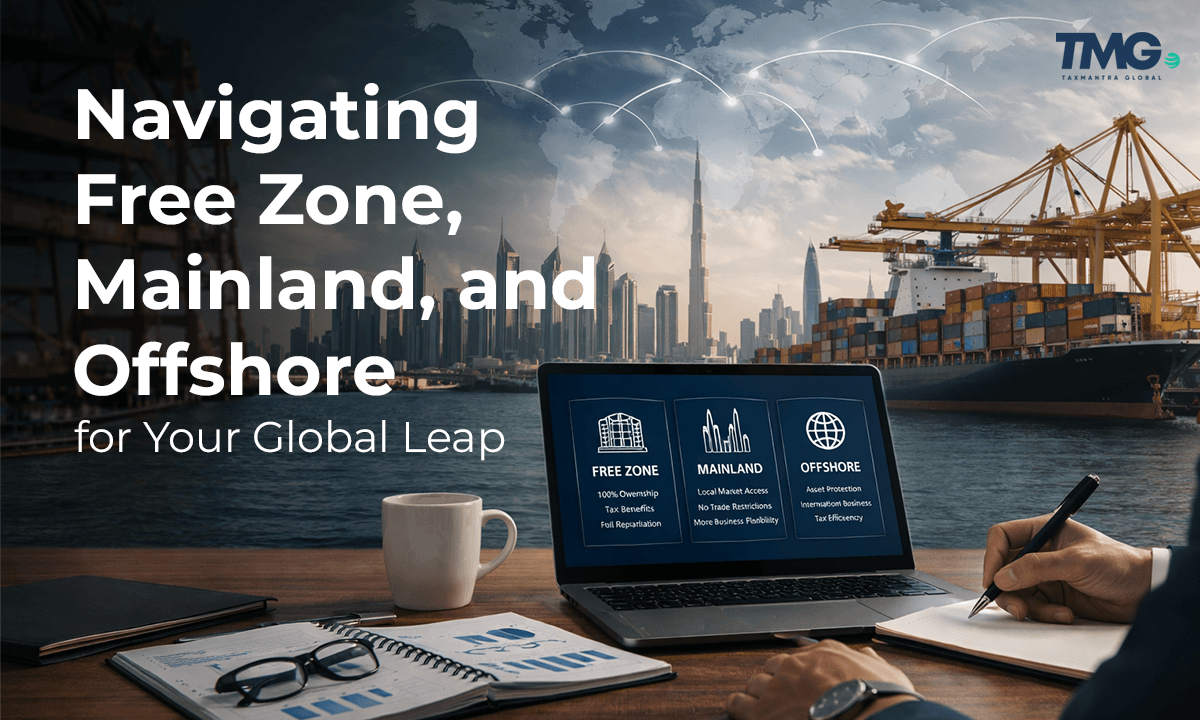
Let’s pull back the curtain on the three pillars of the Dubai business landscape: Free Zone, Mainland, and Offshore.
1. The Free Zone: The Greenhouse for Digital Nomads and Global Traders
Think of a Free Zone as a greenhouse. It is a protected, highly optimized environment designed to help specific industries flourish. Originally created to attract foreign investment, there are now over 40 multidisciplinary Free Zones in the UAE, ranging from Dubai Internet City to the Dubai Multi Commodities Centre (DMCC).
The Human Side of Free Zones: For the consultant who spends their life on Zoom, or the e-commerce founder shipping products to Europe and North America, the Free Zone is a sanctuary. It offers a sense of total control. You own 100% of your company, you don’t need a local physical partner, and the paperwork is remarkably lean. It’s designed for the entrepreneur who wants to move fast, stay digital, and keep their tax exposure at a literal zero.
The Reality Check: However, every greenhouse has walls. The catch with a Free Zone is that you are technically prohibited from trading directly within the UAE Mainland market. If you’re a recruitment consultant in a Free Zone, you can’t easily walk into an office in Downtown Dubai and sign a contract to provide local staff without a middleman or a specific distributor.
The Verdict: If your eyes are fixed on the global horizon and you want a plug-and-play setup with minimal compliance headaches, the Free Zone is your best friend.
2. The Mainland: The Heavyweight Choice for Local Dominance
If the Free Zone is a greenhouse, the Mainland is the open field. This is where the real, unrestricted commerce of the UAE happens. A Mainland license (issued by the Department of Economy and Tourism) is the gold standard for entrepreneurs who don’t just want to be in Dubai, but want to own a piece of the local market.
Why Serious Players Go Mainland: In years past, Indian entrepreneurs were hesitant about the Mainland because it required a local Emirati partner to hold 51% of the shares. Today, that barrier has largely vanished for most commercial activities, allowing 100% foreign ownership.
A Mainland setup gives you the Key to the City. You can bid for massive government contracts, lease a physical retail space in the world’s biggest malls, and provide services to any company in any corner of the Emirates. There is a psychological weight to a Mainland license; it signals to local banks and partners that you are here for the long haul.
The Trade-Offs: Total freedom comes with total responsibility. You will deal with more rigorous auditing, mandatory physical office requirements, and a slightly more complex registration process. It’s more expensive upfront, but in the world of business, you often have to pay for the ground you stand on.
The Verdict: If your business model involves retail, construction, or providing services directly to the people living and working in Dubai, Mainland isn’t just an option—it’s a necessity.
3. Offshore: The Invisible Anchor for Wealth and Assets
Offshore is the most misunderstood of the three. It is often marketed as the cheap way into Dubai, but using an Offshore setup to run an active business is like trying to drive a car with no wheels. It looks the part, but it won’t take you anywhere.
An Offshore company (often registered in JAFZA or RAKICC) is a paper entity. It doesn’t give you a visa, it doesn’t give you an office, and it certainly doesn’t give you the right to trade within the UAE.
The Strategic Use Case So, why do people do it? For sophisticated wealth management. If you are an entrepreneur with assets scattered across the globe, an Offshore entity in Dubai acts as a secure, tax-efficient holding tank. It’s perfect for owning intellectual property, holding real estate, or acting as a parent company for various international subsidiaries. It provides a layer of privacy and asset protection that is world-class.
The Verdict: If you are looking for a residency visa or a place to sit and work, stay away from Offshore. If you are looking to shield your global assets under a stable jurisdiction, it’s a masterstroke.
The Brutal Truth: Moving Beyond the Cheap Mindset
When we talk to entrepreneurs about business setup, the first question is almost always: “Which one is the cheapest?“
This is a dangerous mindset. In Dubai, the cheapest setup often becomes the most expensive mistake within 18 months. Why? Because shifting your license type later is a bureaucratic nightmare. It involves liquidating one company, canceling visas, and re-starting from scratch with another.
Instead of asking about cost, ask about pathways.
- Where will your first $100,000 in revenue come from?
- Will you need to hire a team of 10 people in a physical office next year?
- Does your business require you to be physically present in the UAE to sign deals?
At a Glance: The Strategic Comparison
| Feature | Free Zone | Mainland | Offshore |
| Primary Goal | International Export/Services | Local UAE Market Access | Asset Holding/Privacy |
| Physical Presence | Flexi-desk or Small Office | Mandatory Physical Office | None Allowed |
| UAE Trading | Restricted (requires agent) | Unrestricted | Prohibited |
| Visa Eligibility | Yes (limited by office size) | Yes (unlimited) | No |
| Setup Speed | Very Fast (3-7 days) | Moderate (10-15 days) | Fast |
Final Thoughts
Success in Dubai isn’t about the act of registration, it’s about the strategy of placement. If you choose a Free Zone, you are choosing efficiency and a global outlook. If you choose Mainland, you are choosing to weave your business into the very fabric of the UAE’s domestic economy. If you choose Offshore, you are choosing to protect what you’ve already built elsewhere. Dubai is one of the most powerful growth engines in the modern world. It offers a level of safety, infrastructure, and tax efficiency that is hard to match. But the engine only works if you put the right fuel in the right tank. Don’t make an emotional decision based on a flashy brochure. Make a strategic one based on where you want your business to stand three years from today.
Tags: Business Setup in Dubai, Dubai Free Zone Company Registration, Dubai Mainland Company Registration, Free Zone, Free Zones in the UAE, Mainland